










Introduction
Big Walk, developed by House House (the creators behind Untitled Goose Game) and published by Panic, launched in August 2026 for PC, PlayStation 5, and Nintendo Switch 2. Moving away from solo stealth mischief, House House delivers a co-op-only puzzle adventure where the central mechanic isn't combat or platforming, it is communication.
Supporting parties of up to 12 players, the game drops goofy, triple-stacked ball avatars into a vast, sprawling open world with no explicit tutorials or objectives, forcing players to navigate, cooperate, and invent their own shared language. Garnering widespread critical acclaim, including a 9/10 Editors' Choice from IGN, Big Walk stands out as a unique, highly collaborative social simulator.
Narrative & Storytelling
Big Walk completely eschews traditional linear campaigns and explicit story cutscenes in favor of emergent, player-driven narrative. Dropped initially into a "playground" area with minimal instructions, players learn that to know this world is to name it. Storytelling unfolds naturally through shared experiences like getting lost in pitch-black nights, falling off cliffs with vital equipment, or launching flares across mountains to reunite separated group members.
The light overarching progression centers on finding mysterious, peanut-shaped "red beans" by solving puzzles and delivering them back to "bean towers." Unlocking these towers yields keys that grant access to new tools and shortcuts like chairlifts or trains. The narrative relies entirely on community investment: your group's personal jokes, body language ciphers, and invented terms form the emotional heart of the journey.
World & Environments
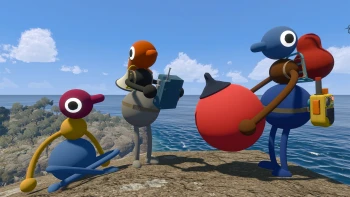
The world contrasts its charming googly-eyed avatars composed of stacked, colorful spheres with twig legs against a realistic, lifelike natural landscape filled with lush foliage, desert cliffs, and breaking ocean waves.
Brightly colored, abstract puzzle structures like orange colosseums, green horror houses, and blue sound stages dot the realistic wilderness. A dynamic day-night cycle shifts the mood from sun-soaked exploration to pitch-black survival, where flashlights become essential. The audio design shines through proximity-based chat with realistic acoustic physics: voices muffle behind thick walls and echo deeply through underground tunnels.
Gameplay Mechanics
Core Loop
Players explore the island, discover scattered puzzles, solve them to obtain red beans, and deposit those beans into regional towers to unlock tools that expand traversal capabilities.
On-Field Mechanics
The gameplay focuses heavily on spatial navigation and communication under deliberate physical constraints:
Proximity & Spatial Audio: Players wandering too far out of earshot lose voice communication unless they use walkie-talkies.
Non-Verbal Systems: When voice fails or tools are dropped down a ravine, players must rely on arm gestures, laser pointers, signals, and body language to coordinate.
Physics & Tool Management: Flashlights, walkie-talkies, and flares can be physically dropped or lost, turning simple journeys into chaotic rescue missions.
Mode-Specific Features
Adaptive Puzzle Scaling: Puzzles dynamically adjust based on party size, accommodating groups ranging from pairs to four or more players.
Creative Puzzle Types: Puzzles range from blindfolded obstacle courses guided by yelling teammates to soundproof room audio-matching and synchronized, multi-platform button presses.
Review
Pros
Unrivaled Co-Op Innovation: Uses communication constraints to foster genuine teamwork and memorable emergent moments.
Clever Puzzle Design: Varied, fair, and open-ended challenges that reward group creativity rather than execution speed.
Atmospheric Polish: Excellent proximity voice physics and a vibrant world encourage casual "hanging out."
Cons
Host-Bound Saves: Save progression is tied strictly to the session host, restricting companions from progressing on the same world state independently.
Finicky Movement: Occasional physics glitches can leave characters briefly stuck in terrain during complex platforming.
Mandatory Multiplayer: Impossible to play solo; requires a dedicated group of friends to experience at its full potential.
Conclusion
Big Walk is a triumph in cooperative game design, proving that forcing players to adapt and build their own systems of communication can be far more rewarding than standard quest objectives.
House House has crafted a delightful digital playground that turns simple miscommunications, lost flashlights, and shared victories into unforgettable stories. Despite minor save-file inconveniences and mandatory multiplayer requirements, it stands as one of the most inventive and joyous multiplayer titles of the year—a must-play for groups looking to truly connect and play together.